Heading 5
Embracing Radiance
EMBRACING RADIANCE BLOG
I begin this blog with a review of Embracing Radiance to explain why it was written and what it is, especially for me. This review appeared in Booklife a publication of Publishers Weekly, the bible of the publishing industry.
Embracing Radiance
Alan McKee, author
"Myth, memory, and longing converge in McKee’s interconnected short stories, a visionary collection of fables about anguish, liberation, and the embrace of inner radiance. Each story revolves around a character on the brink of despondency, who encounters visions, voices, or uncanny figures that steer them toward a harrowing, revelatory path to wholeness. Bound together by the Lady of Eternity, a multidimensional being who represents the Divine Feminine, McKee’s narratives draw on archetypes of despair, innocence, and resilience. These modern parables present pain as a necessary rite for transformation; it also functions as a portal for his characters to glimpse transcendence.
Themes of silence, suffering, and redemption recur throughout Embracing Radiance, and McKee’s invocation of the Divine Feminine, who offers healing and compassion, serves as an intuitive, maternal source of comfort and radiance. In “The Burning Child,” a knight must accept a wound that never heals; the abused child in “The Boy Who Loved Rain” finds emotional release during storms by controlling lightning; and “The Tree of Silence” describes a child’s withdrawal into self-imposed deafness following his mother’s death. Meanwhile, “A Radiance of the Past” details a writer’s life-changing encounter with a cryptic piece of graffiti, one that invites a feminine Presence to fill him with devotion and renewed purpose.
McKee’s prose is lush, incantatory, and imbued with fantastical imagery: children who long to be fawns, houses that reveal enchantments, mothers who transform into wolves. These stories have a mythopoetic resonance, with characters serving as vessels for universal concerns rather than individuals with interior lives. McKee heads each story with his own evocative illustrations that serve as visual echoes of the dream states his characters inhabit, drawing readers into his mindset without providing easy interpretations. Contemplative and haunting, Embracing Radiance offers an archetypal vision of human tribulation and the forces that guide us forward into profound understanding."
The Loss of the Sacred in Society
Anyone older than the age of fifty has their own most negative list of changes in human society during the last century, but I believe that no matter what they are, most stem from the same cause: the loss of the sacred as an important first hand experience.
Yes, churches do still exist, but to what extent do these organizations truly foster direct spiritual experience? Perhaps a handful, but most western churches foster orthodoxy, adherence to a given set of spiritual beliefs and activities. The idea of having one's own unique spiritual experience and formulation is not admitted to any of the standard "faiths" of the west. However, in the east there is more flexibility than in the west. In the east some worshipers are even encouraged to make spiritual explorations and to accept only what they have experienced. However, these are a minority. Even so, belief and experience of the sacred in everyday life does exist in Asian countries and in some, it even flourishes. To go to Mumbai and get on a bus might bring the rider face to face with a personal altar created by the driver, glorifying the god or goddess to whom he or she feels closest. It is truly in our western society where we have lost a genuine belief and value and sense of closeness for the sacred.
In the west, spirituality takes a very distant place in our set of values and consequently is rarely applied in the day to day arena of our lives: at work places, in frequency of worship, as something that acts as a bedrock for all our important activities. For most people, spirituality is considered if at all, last, as a measure of what we do or do not do. This fact is, I believe, the cause of almost all the agreed upon ills of western society: crime, violence, laxness of moral code, etc. Only a handful of people today would ever use the expression "God fearing." God, no matter what form he or she takes, seems to scare or inform very few people today. Some people think this is a good thing—the retreat of superstition. However, I do not. Not that I think God should be scary, but it is much better for society if She is real, a part of our lives. Again, some will point to places like India and say something to the effect, "Look at how superstition has kept this country down."
I say, "Only if we judge progress and goodness on the basis of financial measurements of "good." I believe that is not true if we measure on the basis of inner human development, true joy and happiness and the ultimate positive development of human society, because the only growth we have now is technological and financial—are these the only yardsticks by which we choose to measure ourselves? Because by all other measurements we have fallen far behind our forbears.
We have almost constant warfare on a larger scale and because of "technological growth" we now live in the shadow of the destruction of our own species and the possible destruction of our own world. Not even chimpanzees, our closest relatives in the biosphere, conduct their wars in a way that could destroy the place they live. "Community" is something most people feel they lack, and it is the minority of young people who feel they have found work or a belief system that will satisfy and grow with them into old age.
I believe a recent large study found that Americans are divided about half and half as far as a belief in a Supreme Being goes. But how many feel that they have a direct, communicable link to that Supreme Being? How many of us can talk to God as the Elders of the Bible did? Again, many will tar a statement like that with the brush of fantasy and mythology, something untrue in a fundamental way.
I believe that having a personal God is a choice, one that we can make at any time, and one that will make anyone's life richer and sweeter for having—and one that will give humanity a more joyous, peaceful and worthwhile future.
A Post about Viktor Frankl, one of my heroes
Viktor Frankl, the psychiatrist and Holocaust survivor, came to a conclusion that still feels quietly radical today:
that meaning, not pleasure or power, is the deepest human drive.
In the most extreme conditions imaginable, Frankl observed that those who survived were often not the strongest, but those who could locate a why — a reason to endure, to suffer toward something rather than merely through it. His work, especially Man’s Search for Meaning, reminds us that life does not promise happiness, but it does offer meaning — if we are willing to listen for it.
This insight sits at the heart of my novel Embracing Radiance.
Embracing Radiance is not a story about escaping suffering, but about discovering what can be revealed within it. Like Frankl’s philosophy, the book explores the idea that even in darkness — grief, loss, spiritual confusion — something luminous can emerge. Not because the pain is justified, but because human consciousness has the mysterious capacity to transform it.
Frankl wrote that we are always free to choose our attitude, even when everything else is taken away.
Embracing Radiance asks a related question:
what happens when we stop resisting life’s hardest truths — and instead, learn to meet them with presence, attention, and courage?
Perhaps radiance is not something we achieve.
Perhaps it is something we allow to appear when meaning is embraced, rather than avoided.
Where is The City of Hope?
Where is The City of Hope? It’s a place we all have inside of us, some place or thing that we can still believe in, whether true or false. Most recently “The City of Hope” is an image printed on metal appearing in Toronto in the Ascent Gallery at the Etobicoke Civic Centre. It’s an image with a double meaning because it is based on a shot I took when my wife was treated at the Mayo Clinic, one of the best, if not the best hospital in the world. See it in this post or if you’re in Toronto, come and see “City of Echoes, Voices of Art” at the Ascent Gallery, 399 The West Mall, Etobicoke ON M9C 2Y2.
#Etobicokeciviccentre #ascentgallery #Mayoclinic #Faith #Hope #metalart #contemporaryart #spiritualart #architecture #architecturalart #alanmckee #embracingradiance #183gallery #amazingmossparkartists #amazingmossparkart #austinmccauley #spiritual #reincarnation
A really good idea of what reincarnation actually is
When talking or even thinking about reincarnation it can be difficult to think or speak only in generalities. With that in mind I began searching online to see if I could find anything that was at once concrete and specific and yet authoritative and credible about reincarnation. There are certainly a multitude of "gurus" who claim to have knowledge of reincarnation. But very few that met my own personal standards of credibility. Finally, though, I came across two films by a Tibetan film maker whose work had all the credentials that I found satisfying. The film maker, Tenzing Sonam, comes from a culture which accepts reincarnation as a proven reality and has done so for hundreds of years. In addition, he learned his craft in western universities where training is state of the art. His education also meant he had been heavily exposed to western beliefs about reincarnation as well as the philosphies of his homeland.
Finally, I watched his films. They had the unmistakeable ring of matter-of-fact truth, even though they were recreations of events that had already happened. Of course, that is my judgment. Yours may be different, though I doubt it.
The first film is called: The Reincarnation of Khensur Rinpoche. The subject of the film, Khensur Rinpoche, was a highly respected teacher and a Tibetan lama whose knowledge and spiritual power were sought by many Tibetans. The first film is written from the point of view of his lifelong companion and student, Choenzey, who sets out to find his master's reincarnation four years after his death. At last he receives a letter that puts him on the track of a young boy recently born in communist China. The Chinese communists are rabid enemies of the government of the Dalai Lama and all who support him. Ignoring the potential dangers, Choenzey sets off for China to interview the possible candidate of his reincarnated master. After meeting the child and his parents, Choenzey is convinced that the young boy is his reincarnated master. The rest of the film documents further tests of the boy by the Dalai Lama himself and the State Oracle of Tibet, a holy man credited with the ability to see with clairvoyant powers. I will not spoil the film by saying more, but if you are seriously interested in reincarnation as a fact and not merely a curiousity, I urge you to see this film.
Embracing Radiance, the book that my site is based on was written over a space of nearly sixty years. It is made up of 13 very short stories which are about different people and different settings yet, they are actually parts of the same whole, they are aspects of the same kind of multi-dimensional entity I believe we are all parts of. You can think of it as a kind of reincarnation. We are all here to learn how to express our many aspects and talents, and in order to do that we take on different personalities, settings and circumstances. Unfortunately, we often forget why we are here since, we have to learn new lessons in each character we become. The result is that we become so involved with the current character we incarnated, we lose our true selves, our most complete and best expressions of who we really are. I believe that I was given the task of writing something that would help remind people who they are and what they really are. That does not make me special or important; it's a job I was given because I have the necessary make-up to do it. Nothing more.
I want to try to use this blog to talk about things from the point of view described above. If you'll drop by once in a while I'll do my best to make it interesting. If you'd like to purchase a copy of Embracing Radiance, go here: bit.ly/3JpyH1O
The Book I didn't set out to write
Usually, an experienced writer sets out to write with a clear objective. The form, meaning, purpose, etc. all are normally determined before one starts to write. That's the way I was taught to work as well. Beginning when I was very young, I helped my father, Alvin Schwartz, now an acknowledged "star" of the "Golden Age" of comics (the thirties and forties of the last century) plot comic book stories. For hours on end we would toss around ideas: "how did Superman do...," "what was the weapon Lex Luthor used to defeat Superman in this scene, how does Superman foil him...you get the idea. Plotting was purposive. In those days, a comic book had to have a beginning, a middle and an end. That's where I started and how I grew up with writing.
It was only years later that I discovered that sometimes the best work, best ideas, structure, language, and so on often wasn't consciously planned. Once I had reached a certain stage of skill (in my case, mid to late teens) I often found that some of the best work came from a part of me I didn't know and couldn't define. It came from some place beyond my conscious self. The solutions to stories often presented themselves, fully resolved, to my conscious mind. And I found that the more I trusted this unknown part of myself the better the result. Now, I want to emphasize, the skill came first, years of it. Only after this apprenticeship did my unknown self do great things unbidden.
Now, I am definitely at the other end of my career, but once again, I find that the best, most interesting work I have written often came unbidden, at unexpected times and created its own order without any conscious planning on my part. That is exactly how my recently published novel, Embracing Radiance, came into existence. I had a very vague idea of a kind of book I wanted to write "one day."
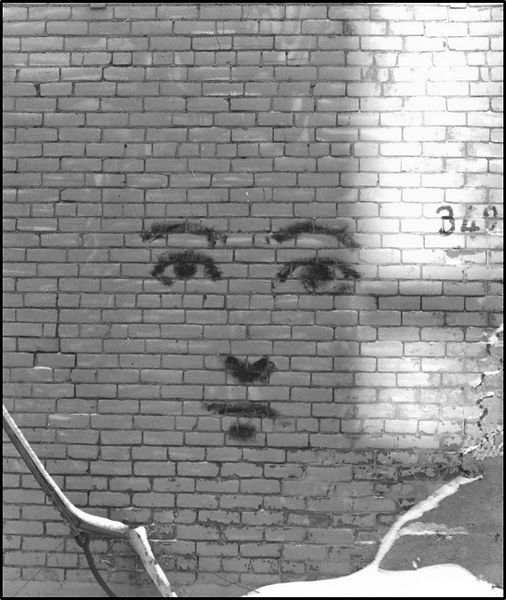
Then, something extraordinary happened when I was in my early twenties: I saw an image, a piece of grafitti, you would call it, painted on a shed one night near my front door. The image took all my years of writing and galvanized them into a desire to "explain" (origin myth) how the image came to be. Since I could not know the factual answer, I had to invent it and nothing seemed too difficult to succeed in creating an "origin myth" for that image.
I taught myself analog photography with a black and white film camera so I could keep the image forever. Since I wanted to take it at night and wanted a very special kind of light, it took me months to master the night lighting I wanted for the image.
Then, off and on, over a period of sixty years a story idea would come to me and I would write it down, with very little re-writing, again, coming from the deeper part of myself. It was only after sixty years of this process that I realized that all the stories were connected and part of a longer story, a novel. And that was how I wrote, Embracing Radiance. My other books on Amazon were historical novels and one how-to.
So I hope this post encourages other people who want to write, to learn the conscious skills and then trust their own inner voice.
The Power of Art
Do you believe that these 11 brushstrokes can change a man’s life?
They changed mine. This image sent me on a pilgrimage that has lasted nearly sixty years. Can you believe that?
In my novel, Embracing Radiance, a dying man’s final painting shatters another man’s life and sparks a pilgrimage across time, space, and even death itself.
What actually happened, though, is, in some ways, even stranger. One morning I woke up and saw this painted on a brick shed in the alley where I lived in Montréal. I felt such an energy in this casual painting, that I wanted to know how this image had gotten created. The thought possessed me but no one could tell me.
I was so struck by this image that nearly sixty years ago, with no previous experience, I actually learned how to use a completely manual camera (Nikon FE) in order to photograph the image at night. (The image here was taken in the morning and was one of thirty or forty I took around the clock for weeks on end.) I kept a diary of each shot with exact exposure notes.) As a result, I eventually became a digital photographic artist with shows in Toronto and New York: www.alanmckee.com. I also doubled my income when I moved from being a copywriter who wrote for international clients to being a creative who produced every aspect of the work I did for clients, everything from words to images to layout. Eventually, I produced final printing films for print runs in the millions of pieces.
Though I searched learn more about this image, I finally realized that I had to tell the story of the radiant painting in the alley as I believed it might have happened. But I had no idea where to start until I had a dream that gave me the creation story I had sought.
After that, years went by and all I had was a four page short story. Then, more than ten years later, I had another dream about a young girl in a mental asylum. And this is the way that all 13 parts of Embracing Radiance was written: years apart and each short story seemingly disconnected from the other. But
NOW, after almost six decades I have the complete story, only realizing that the twelve short stories were actually part of a single story that told the story of a man’s life from youth to death. In the most real way, Embracing Radiance, is my story, a story of a search for meaning a story that really happened.
So remember, Art is never just art—it’s a portal. What art has transformed your life?
hashtag#Art
hashtag#ArtistOnInstagram
hashtag#ArtOfTheDay
hashtag#Artwork
hashtag#ArtLovers
hashtag#Creative
hashtag#ArtCommunity
hashtag#EmbracingRadiance
hashtag#InspiredByArt
hashtag#ArtStory
hashtag#ArtLife
hashtag#Photography
hashtag#ArtisticSoul
Ignite Trust in Your Creativity: My Story for Every Professional
I believe the journey from anguish to illumination isn't just for artists—it's the core of every profound creative and professional breakthrough. It certainly was for me.
In my collection, Embracing Radiance, I offer my powerful perspective on how suffering can not only be transformed into light but also offer a blueprint for embracing risk and trusting that inner, guiding voice.
If you're a creative professional or focused on innovation, this book is an essential read. It speaks directly to the creative process, showing that the deepest challenges we face can be the very catalyst for our greatest awakening and best ideas.
What Reviewers Are Saying
I'm incredibly honored that Publishers Weekly’s BookLife hails the collection as:
“visionary… a lush, incantatory journey into anguish, liberation, and the embrace of inner radiance.”
They also praised the book's “mythopoetic resonance” and “fantastical imagery,” concluding:
“Contemplative and haunting, Embracing Radiance offers an archetypal vision of human tribulation and the forces that guide us forward into profound understanding.”
At the Heart of the Narrative
Central to the collection is Our Lady of Eternity, a multidimensional figure representing the Divine Feminine—a compassionate force guiding wounded souls toward healing and illumination.
My goal was for each story to turn pain into powerful revelation, weaving together myth, spirituality, and visual art. A few highlights include:
A knight learning to accept a wound that won't heal in “The Burning Child.”
A child finding freedom by controlling lightning in “The Boy Who Loved Rain.”
A writer discovering renewed purpose through a cryptic piece of graffiti in “A Radiance of the Past.”
If you think Embracing Radiance could shed light on some of your life questions and help resolve some of your own challenges, I urge you to return to home page and get your copy now. At least, think about how some new ideas could bring new light (radiance) into your life right now.
The Most Valuable Thing I Know
Today I am going to post about the most valuable thing I know. When I was very young I used to have dreams where I would walk around my home, fast asleep and repeat over and over: "There's a key to everything. All you've got to do is find the key." Even as a six year old I felt deeply convinced that my words were true. And I have never changed my mind.The habit I am going to write about now comes as close to fulfilling that statement as anything I have ever read or thought. This brings me to my second qualification for writing about this subject: for about a decade I was the chief copywriter and often editor for Nightingale-Conant Coporation, publishers of the most extensive library of self-development training courses in the world. I encountered everyone from Napoleon Hill to Tony Robbins to Wayne Dyer. And I didn't just read them, I had to know their ideas well enough to re-write parts of it to make a better presentation without doing wrong to their bedrock material.
So what is this amazing, incredible habit I'm talking about that can provide such wonders? The man who wrote about this habit, first, a great pioneering psychologist and philosopher was William James. He called it, "The Habit of Effort," and this is what he said,"Keep the faculty of effort alive in you by a little gratuitous exercise every day. That is, be systematically ascetic or heroic in little unnecessary points, do every day or two something for no other reason than that you would rather not do it, so that when the hour of dire need draws nigh, it may find you not unnerved and untrained to stand the test."
My own life experience has taught me that James was right. Not in a small way but in a way that does provide absolute life mastery as nothing else I've ever encountered (sorry, Tony). Unfortunately for most of us in the 'developed' world, we have been running in the opposite direction for the last two centuries, continually trying to 'get more for less time, money or effort'. Think of the phrase, "labour saving," and the society we have built upon the universally accepted desireability of 'getting more for less".
I don't overtly mention the habit of effort in my own recently published book, Embracing Radiance. But the idea is there, built into the thirteen stories, if you look for it. But the habit of effort is so important, I decided that I should point it out in this post so that no reader could miss it.
I profoundly believe we all badly need an antidote to the constantly repeated idea that reducing effort is what we should all aim at, especially with technologies like artificial intelligence and our increasingly computerized world. I see that road as leading to complete ruin and emptiness for us all.
hashtag#William James | Life, Books, Psychology, Contribution, & Facts
hashtag#Nightingale-Conant Personal Development
What do you in your heart of hearts believe about reincarnation or immortality?
Anyone who has practiced true self-observation knows that he or she is a multiplicity of conscious states, held together by a physical frame. But is there more? Is there a self that rises above both the changing states of consciouness and the physical frame? That is the real question for all humanity. My own feeling is that there is something beyond the changing states of my thoughts and my physical sensations. What do you believe? Because really, that is what matters. We can choose to live our lives as if we are moth-like, short lived creatures that rise and fall with the seasons or we can live as if we were immortal, traveling through space and time eternally.
In many ways, this is a choice we must all make. I decided many years ago that I would believe in God and immortality because it was a more useful belief than not believing in Her or my own permanent existence. For if we cannot know the truth absolutely, then we can still choose how we wish to live, according to which belief. I also believe that there are some people who have been able to know the truth about human life. These are the great teachers who have left their thoughts to humankind. But I believe there are also those of us who live quiet, unknown lives who can and have also known the truth about their existence. These are the truly blessed ones among us: to truly know their own immortality and to not have any need or mission to share that knowledge.
A belief in immortality also fosters, I think, a greater moral convinction. There is more at stake. How we live each moment does matter because it will effect our eternity, because as "we sow, so shall we reap," a statement based on common sense and experience.
What do you believe? And how does it affect the way you live your life?